Building a Shopify store in 2026 can cost anywhere from a few hundred dollars to tens of thousands, depending on what you’re actually building.
A basic store using a pre-built theme and a handful of apps is relatively straightforward. A truly custom Shopify store can involve much more: brand assets, custom theme development, Liquid and JavaScript customization, product catalog setup, conversion-focused page design, SEO, payments and checkout configuration, and integrations with tools for email marketing, customer support, analytics, CRM, inventory, and more.
The Shopify subscription is only one part of the cost. The biggest variable in development is the scope of the build.
You don’t necessarily need a $10,000+ ecommerce project to launch a professional, high-converting Shopify store. In many cases, a focused custom build can deliver the design, functionality, and customer experience a growing brand needs without paying for unnecessary complexity.
In this guide, we will break down what actually goes into the cost of a custom Shopify store in 2026, what you can expect at different price points, which features increase the budget, what you’ll continue paying after the build, and where it’s worth investing, and where it isn’t.
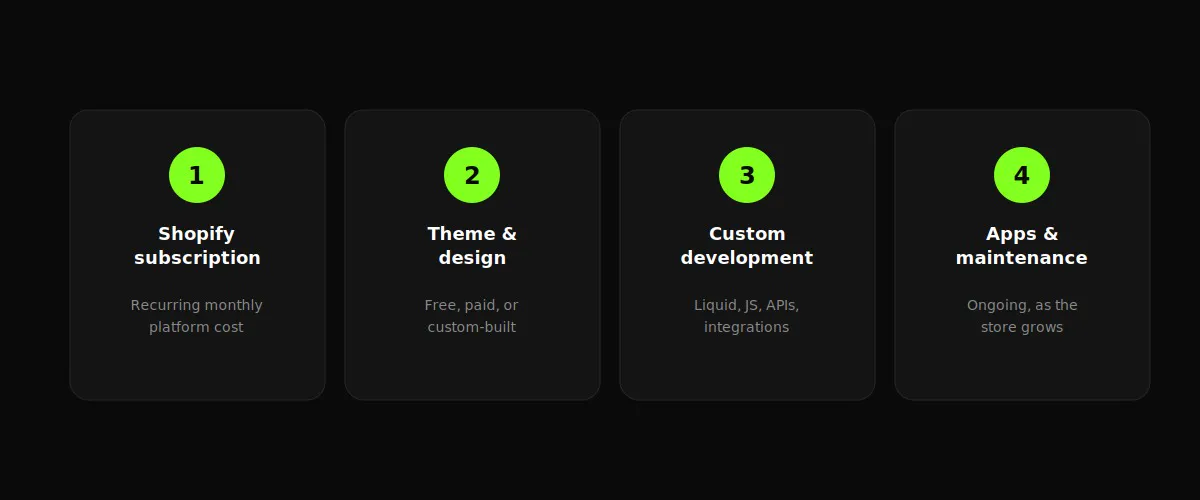
The Real Four Cost Components
1. Shopify subscription
Shopify charges a recurring monthly subscription for hosting and running your store. The exact price depends on the plan you choose and can range from a relatively low-cost plan ($39/month) for an individual business to significantly more expensive plans ($399/month) for larger businesses and enterprises.
This is the cost of using Shopify as your ecommerce platform, not the cost of actually building your store.
2. Theme and design
Your theme determines much of your store’s visual structure, including layouts, typography, navigation, product pages, collection pages, and other storefront components.
You can use a free Shopify theme, purchase a premium theme, or have a developer customize or build the theme around your brand and requirements.
A premium theme is usually a one-time purchase, while custom design and theme development are part of your overall development budget.
3. Development and custom functionality
This is where the cost of a Shopify build can vary the most.
A basic store may only require theme configuration and minor customization. More advanced stores can require custom Liquid, JavaScript, CSS, Shopify APIs, and third-party integrations to create functionality that isn’t available out of the box.
You can hire a freelancer, Shopify specialist, or ecommerce agency for this work. The price depends largely on the scope, design requirements, number of templates, custom functionality, integrations, and overall complexity of the project.
4. Apps and ongoing maintenance
Many Shopify stores use third-party apps for functions such as reviews, email marketing, subscriptions, customer support, analytics, inventory management, loyalty programs, and more.
Some apps are free, while others charge monthly or usage-based fees.
You should also account for ongoing maintenance as your business grows. This might include updating functionality, improving conversion rates, fixing issues, adding new features, optimizing the storefront, or integrating new tools.
These costs aren’t necessarily required on day one, but they can become part of the store’s ongoing operating budget.
Shopify Plan Costs
Before calculating the cost of building a Shopify store, you need to account for Shopify’s own subscription. This is an ongoing platform cost rather than a development expense: it covers the infrastructure you use to host your store, manage products and orders, process checkout, and run the business from Shopify’s admin. Shopify also includes hosting, unlimited bandwidth, and SSL with its plans, so you don’t need to purchase conventional web hosting separately.
As of August 2026, Shopify’s main plans are:
| Plan | Monthly billing | Annual billing* | Best suited for |
|---|---|---|---|
| Basic | $39/month | $29/month | Solo entrepreneurs and small stores |
| Grow | $105/month | $79/month | Small teams and growing businesses |
| Advanced | $399/month | $299/month | Larger, higher-volume businesses |
| Shopify Plus | From $2,300/month | N/A | Enterprise businesses |
Annual billing is shown as the effective monthly price when billed annually. Shopify Plus has separate contract terms and pricing.
For most new and small-to-medium ecommerce businesses, Basic or Grow will be sufficient. You don’t need Shopify Plus simply because you’re building a custom-designed store. The Shopify plan and the level of customization are separate decisions: you can have a highly customized storefront running on a relatively inexpensive Shopify plan.
The more expensive plans become relevant when you need additional staff capabilities, advanced reporting, higher-level operational features, or enterprise functionality. Shopify Plus starts at $2,300/month for standard setups on a three-year term, with higher pricing possible for more complex or higher-volume businesses.
Theme Costs: The Real Three Options
There are three main options for your Shopify theme: free, paid, or custom-built. Free themes are a good choice for simple stores, but may offer fewer design and customization options. Paid themes typically provide more layouts, sections, and built-in ecommerce features, making them a good middle ground.
If you need a storefront designed specifically around your brand and business requirements, you can consider custom theme development. A Shopify developer can extensively customize an existing theme or build one from scratch, giving you greater control over design, user experience, and functionality. Naturally, this costs more because you’re paying for development rather than simply purchasing a theme.
Build Cost by Complexity Tier
The cost of building a Shopify store through a developer or agency depends largely on the scope and complexity of the project. A basic store using an existing theme and standard Shopify features requires far less development than a fully customized ecommerce experience.
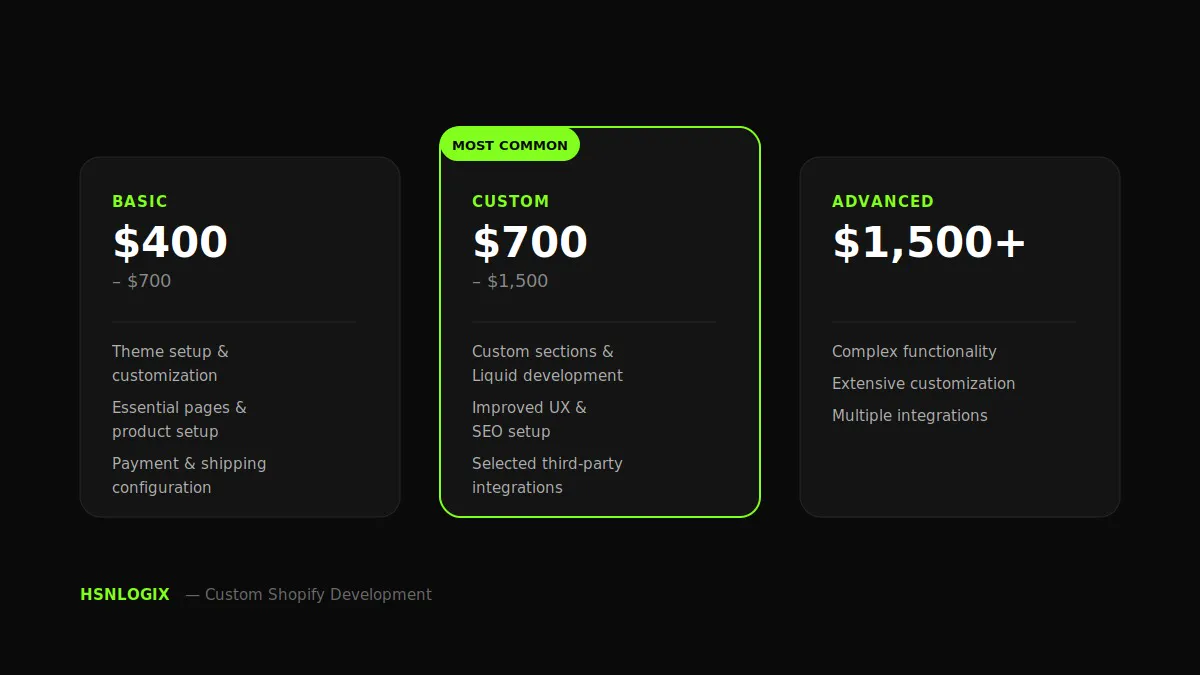
Lighter Shopify work ($500–$1,000): Best for store setup, theme customization, performance audits, or troubleshooting. This typically includes theme setup and customization, essential pages, product/collection setup, payment and shipping configuration, and basic launch setup.
Custom Shopify theme development ($1,500–$5,000+): For businesses that need a fully tailored storefront. This includes custom Liquid/CSS/JavaScript development, custom sections, customized product and collection pages, improved UX, SEO setup, and third-party integrations. Costs increase with custom features, large catalogs, and complex integrations.
These are development costs, not the total cost of running the store. Shopify subscriptions, premium themes, paid apps, domain registration, and ongoing maintenance are separate expenses.
What Actually Drives the Price Up and Down
The biggest factor is scope. A store with 10 products, an existing theme, and standard Shopify functionality is much cheaper to build than a store with a large catalog, custom page designs, advanced product logic, and multiple integrations. Other factors include the amount of custom Liquid/JavaScript/CSS development, number of templates and pages, product setup, third-party integrations, custom features, SEO requirements, and how much design work is involved. The more of these you need, the more development time and a larger budget your project requires.
The Hidden Ongoing Costs Nobody Budgets For
The initial development cost is only part of the total cost of running a Shopify store. You may also need to budget for the Shopify subscription, domain renewal, paid apps, premium themes, payment processing fees, marketing tools, email/SMS platforms, and ongoing maintenance. As your store grows, you may also spend on new features, app integrations, SEO, and technical support. Some of these costs are optional at launch, so it’s better to start with what you actually need and add tools as the business grows.
A Realistic Budget by Business Stage
Your budget should match the stage of your business rather than paying for complexity you don’t need yet.
Lighter work (store setup, audits, and troubleshooting) typically falls in the $500–$1,000 range if branding, products, content, and assets are already prepared. Custom Shopify theme development, for businesses that need a fully tailored storefront with custom sections and integrations, typically runs $1,500–$5,000+. Businesses with more complex catalogs, custom functionality, or multiple integrations should budget at the higher end. The goal is to build what your business needs today while leaving room to expand later.
Shopify vs. Alternatives: Brief Cost Comparison
Shopify may come with more costs than some simpler ecommerce platforms, but you’re paying for a more complete ecommerce system that can support your business as it grows. WooCommerce can have lower platform costs, but hosting, security, updates, and plugins are managed separately. Wix and Squarespace can be a good fit for smaller stores, but may offer less flexibility when your products, integrations, and business requirements become more complex.
Shopify stands out when you need a scalable ecommerce platform with advanced capabilities without managing the underlying infrastructure yourself. Beyond its core storefront and checkout, Shopify supports custom Liquid development, Shopify APIs, custom sections, advanced product and collection experiences, third-party integrations, automated workflows, subscriptions, inventory management, analytics, and integrations with CRM, ERP, marketing, and fulfillment systems. With the right Shopify developer, these capabilities can be combined into a highly customized store rather than relying solely on the functionality of a pre-built theme.
Getting an Accurate Number for Your Store
Every price in this guide is a range, not a fixed quote. Your actual number depends on your catalog size, how much custom functionality you need, whether you’re launching fresh or migrating an existing store, and how much of your branding and content is already prepared.
The fastest way to get an accurate figure isn’t to guess from a blog post, it’s to get an itemized quote from someone who’s actually looked at what you’re building. When you do request quotes, ask for a breakdown, not just a total: what’s included, what counts as a custom feature versus a standard one, and what happens if scope changes mid-project. A vague single number is usually a sign the scope hasn’t been thought through yet.
If you’re figuring out where your project falls, whether that’s lighter setup work in the $500–$1,000 range or a custom theme build starting at $1,500, we’re happy to take a look and give you a real, itemized quote based on your specific store, not a generic range. No cost and no obligation.